A Field Guide · Furniture Resurrection · Phoenix AZ
What’s Really Destroying Your Leather Furniture
What 11 years and thousands of restorations across Arizona taught us — and what most homeowners never knew was possible.
The Hidden Problem
Most people don’t know their leather can be restored.
After evaluating leather furniture in hundreds of Arizona homes, one pattern becomes clear: most people believe their only options are to live with damaged leather or replace it entirely.
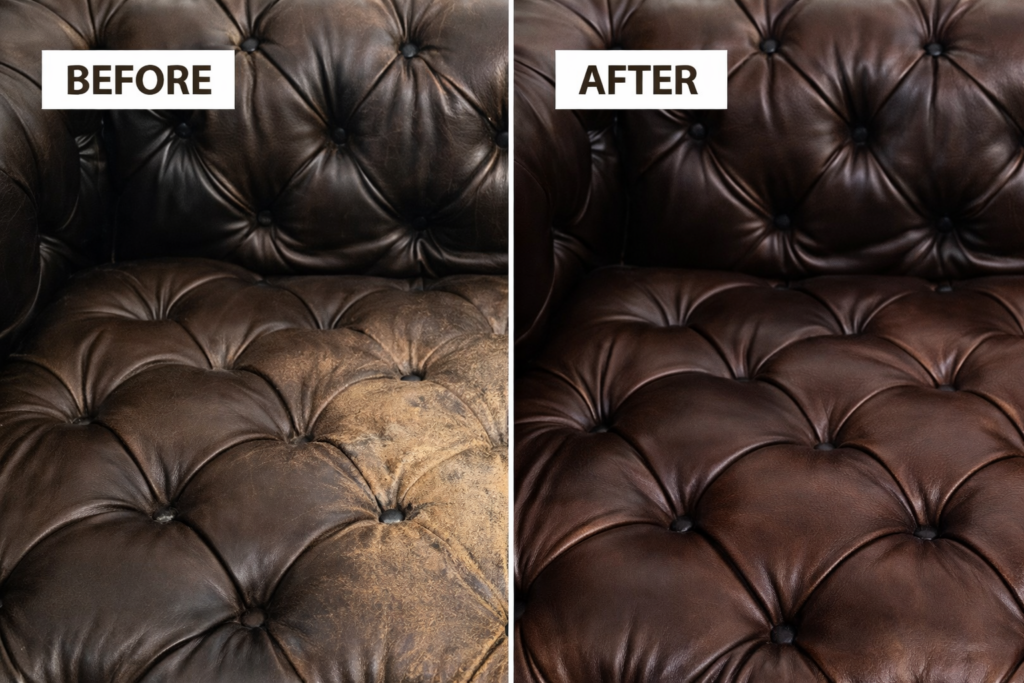
Very few know that a third option exists — that in most cases, leather furniture can be professionally restored to look and feel the way it did when it was new, or better. Most clients who find us have never heard of leather restoration. They discovered it only after years of living with damage they assumed was permanent.
This guide exists to change that. Not to sell you anything — but because leather is a remarkable material that deserves to be understood. And because most of the damage we see every day was completely preventable.
“The damage is rarely what people think it is. And by the time it’s visible, it’s been happening silently for years.”
The biggest cause of leather failure is not sun damage. It is not age. It is not pets. It is the daily contact of human skin — and the absence of proper care to counteract it. Here is what is actually happening to your leather, and why it matters.
Field Observations
The Patterns of Leather Deterioration
These are not theories. These are patterns observed repeatedly in real homes over 11 years of professional restoration work.
Pattern 01
The Body Oil Pattern — The Real #1 Killer
Every day, the oils from human skin transfer onto leather at every point of contact. The headrest. The armrests. The back of the knees. The areas where hands rest. These are the zones where leather fails first — and fastest.
The problem is twofold. The leather itself is dry and depleted of its natural oils — it needs nourishment. But the body oils it absorbs daily are not nourishing. They are destructive. They break down the protective finish from within, quietly and invisibly, long before anything looks wrong on the surface.
How it progresses — what we see in the field
Stage 1 — Dull area appears. The finish at the contact zones begins to lose its tone. Most homeowners mistake this for dirt.
Stage 2 — Protective seal is gone. The clear coat has been broken down. The leather underneath is now exposed and unprotected.
Stage 3 — Color begins to fail. The pigment layer is breaking down. Fading and discoloration become visible.
Point of no return — Oils penetrate through. Body oils have soaked completely through the leather fiber. The damage is no longer cosmetic — it is structural. Full restoration is no longer possible.
Pattern 02
The Neglect Pattern — Leather That Is Dry and Thirsty
Leather is a natural material. Like skin, it needs moisture and nourishment to remain flexible and strong. Without regular conditioning, leather slowly dries out — becoming stiff, brittle, and increasingly vulnerable to cracking.
When we arrive at a home and the leather looks dull and feels dry across the whole surface — not just at the contact points — that is the neglect pattern. The leather has been thirsty for a long time and nobody fed it.
This pattern, caught early enough, is one of the most straightforward to reverse. Caught too late, the window for restoration closes.
Pattern 03
The Wrong Product Pattern — What People Use That Makes It Worse
2-in-1 cleaners and conditioners are one of the most common mistakes we encounter. Cleaning and conditioning are opposite processes. A cleaner opens the surface and removes contaminants. A conditioner penetrates and nourishes. Doing both simultaneously does neither job properly — and often traps the very contaminants it was supposed to remove.
Shine-producing products are the other. If a product makes your leather look glossy immediately after application, it is almost certainly coating the surface with silicone — not nourishing the leather underneath. Healthy leather has a natural, soft, matte finish. The shine is a mask, not a sign of health.
Pattern 04
The “Waited Too Long” Pattern
This is the most common pattern we encounter. The damage was building gradually — a little dullness, slightly stiffer cushions — but nothing that seemed urgent. Then one day it becomes impossible to ignore. A crack appears. The headrest is a completely different color from the rest of the piece.
The window for easy intervention is earlier than most people expect. If your leather looks slightly dull at the armrests or headrest right now — that is the time to act. Not when it looks obviously damaged.
The Third Option
What Most People Don’t Know: Leather Can Be Restored
When we sit down with a homeowner for the first time and show them what professional restoration looks like on a small test area of their own furniture — the most common reaction is genuine surprise.
“I had no idea it could look like this.”
They didn’t know this existed. They had accepted that their furniture was simply worn out. In most cases, it isn’t. Here is what professional restoration can address:
Color Loss & Fading
Hand-mixed color formulas matched to your original leather — blended seamlessly so the restoration is invisible.
Dryness & Surface Cracking
Deep conditioning that rehydrates and strengthens leather that has been neglected — restoring softness and flexibility.
Tears & Seam Damage
Structural and visual repair that reinforces the leather while remaining nearly invisible to the eye and touch.
Protective Seal Damage
Restoration of the clear coat that body oils have broken down — re-establishing the barrier between your leather and daily wear.
Not every piece can be fully restored. When oils have penetrated completely through the leather fiber, the damage is permanent. This is why early evaluation is always worth doing.
Ongoing Care
The Simple Ritual That Keeps Leather Alive
Whether your leather has just been restored or is currently in good condition, the principle is the same: leather needs a regular rhythm of care to stay healthy — especially in Arizona’s dry desert climate.
The system we use professionally, and teach every client after every restoration, is a three-step ritual designed to clean properly, nourish deeply, and protect what’s been built.
Step 01
Clean
Remove body oils and contaminants before they penetrate — always before conditioning, never combined with it
Step 02
Condition
Nourish the leather with proper oils — replenishing what daily life and Arizona heat removes
Step 03
Buff & Enjoy
Restore natural softness and finish — then live with furniture that lasts for decades
This is the same method used in every professional restoration at Furniture Resurrection, and the same system available through The Leather Method™ for homeowners who want to maintain their leather themselves.
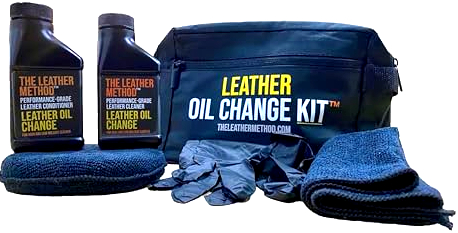
In Arizona, leather should be cleaned and conditioned every three to six months — more frequently for pieces that see heavy daily use.
Common Questions
FAQ: Leather Care & Restoration
Can my leather really be fixed? It looks pretty bad.
Most people who call us believe their leather is too far gone. In most cases they are wrong. After evaluating thousands of pieces across Arizona, the damage that looks the worst on the surface is often still restorable — fading, dryness, cracking, color loss, and body oil damage at the contact zones can all be addressed professionally in most cases.
The honest answer is that we don’t know until we see it. That’s exactly why the Leather Audit exists — to show you what’s possible before you spend anything. You’ll see the difference on a small test area before we proceed. In most cases the reaction is the same: “I had no idea it could look like this.”
I’ve tried products from the store and nothing worked. Why would this be different?
Most store products fail for two reasons. First, many are 2-in-1 cleaners and conditioners — but cleaning and conditioning are opposite processes that cannot be done simultaneously. Second, most products add surface shine without nourishing the leather underneath. Shiny leather is not healthy leather.
Professional restoration works differently. We assess what type of damage is present, clean the surface properly before conditioning, hand-mix color to match your specific leather, and restore the protective seal that daily use has broken down. Products treat the surface. Restoration addresses what’s actually happening inside the leather.
What is leather restoration — I’ve never heard of this.
Most people haven’t — and that’s exactly why we created this guide. Leather restoration is a professional process of returning damaged leather to its original appearance and condition, performed in your home without removing the furniture.
It is not repair in the traditional sense. It is a combination of deep cleaning, conditioning, color restoration, seal repair, and structural work — all done by hand, on site. Most clients discover it exists only after they’ve already been living with damaged leather for years, assuming replacement was their only option. It isn’t.
How long does a restoration take?
Most pieces take between two and four hours depending on the size and extent of the damage. We work in your home — nothing is removed, no pickup, no disruption beyond the appointment itself. We always begin with a small test area so you can see and approve the result before we continue with the full piece.
How do I know if my leather is still restorable or too far gone?
The point of no return is when body oils have penetrated completely through the leather fiber itself — at that stage the damage is structural and cannot be fully reversed. Signs that restoration is still possible: the leather feels dry but intact, color has faded but the surface is not disintegrating, cracks are surface level. Signs you may be approaching the limit: the leather feels brittle or paper-like, the surface is flaking in sheets.
If you are unsure — the Leather Audit will give you a definitive answer at no cost.
Does restoration last? Or will it just look bad again in a few months?
A professional restoration done correctly will last for years — not weeks. What determines how long it holds is what happens after. Every restoration we complete includes a personal care walkthrough and a maintenance kit — because the goal is not to restore your leather once and see you again in five years. The goal is to show you how to keep it alive permanently.
About the Author
Frank Olivas
Leather Restoration Specialist · Founder of Furniture Resurrection · Creator of The Leather Method™

Frank Olivas founded Furniture Resurrection after recognizing a pattern most homeowners never see coming — leather failing silently long before it looks damaged. Over 11 years and thousands of restorations across Arizona, Frank has developed a deep understanding of how leather deteriorates, what actually causes it, and what can genuinely be done to reverse it. He created The Leather Method™ to give homeowners the same professional-grade care system he uses in every restoration.
Next Step
Find Out What’s Actually Possible for Your Leather
If your leather is showing any of the patterns described above, the most useful thing you can do is have it evaluated before the damage progresses further. The Leather Audit is free, in-home, and comes with no pressure or obligation.
Request a Free Leather AuditLearn The Leather Method™
“Leather furniture is not disposable. Sometimes the best decision is simply to keep what you already love.”